Cavity Back vs Blade Irons: The Comprehensive Selection Guide for Golfers
Choosing between cavity back and blade irons is a pivotal decision for any golfer. This guide explores the engineering, physics, and performance characteristics of each to help you find the perfect set.
Parspun is reader-supported. When you buy through links on our site, we may earn an affiliate commission at no extra cost to you.
The information provided in this guide is for educational purposes to help golfers understand equipment technology and design principles.
Understanding the Fundamentals of Iron Design
For decades, the debate between cavity back vs blade irons has dominated the equipment landscape. At its core, this choice represents a trade-off between forgiveness and precision. While modern technology has blurred the lines between categories, the fundamental physics of how these clubs interact with the ball remain distinct. Choosing the right design requires an understanding of how weight distribution influences the outcome of every swing.
The Evolution of the Modern Iron
In the early days of golf, irons were exclusively forged from blocks of steel, resulting in thin, heavy heads. These were the original blades. As the game grew, engineers sought ways to make the sport more accessible. The introduction of investment casting in the mid-20th century allowed manufacturers to move weight away from the center of the clubhead, creating the first cavity back designs. Today, the evolution continues with multi-material constructions that attempt to provide the look of a blade with the help of a cavity back.
Defining the Blade Profile
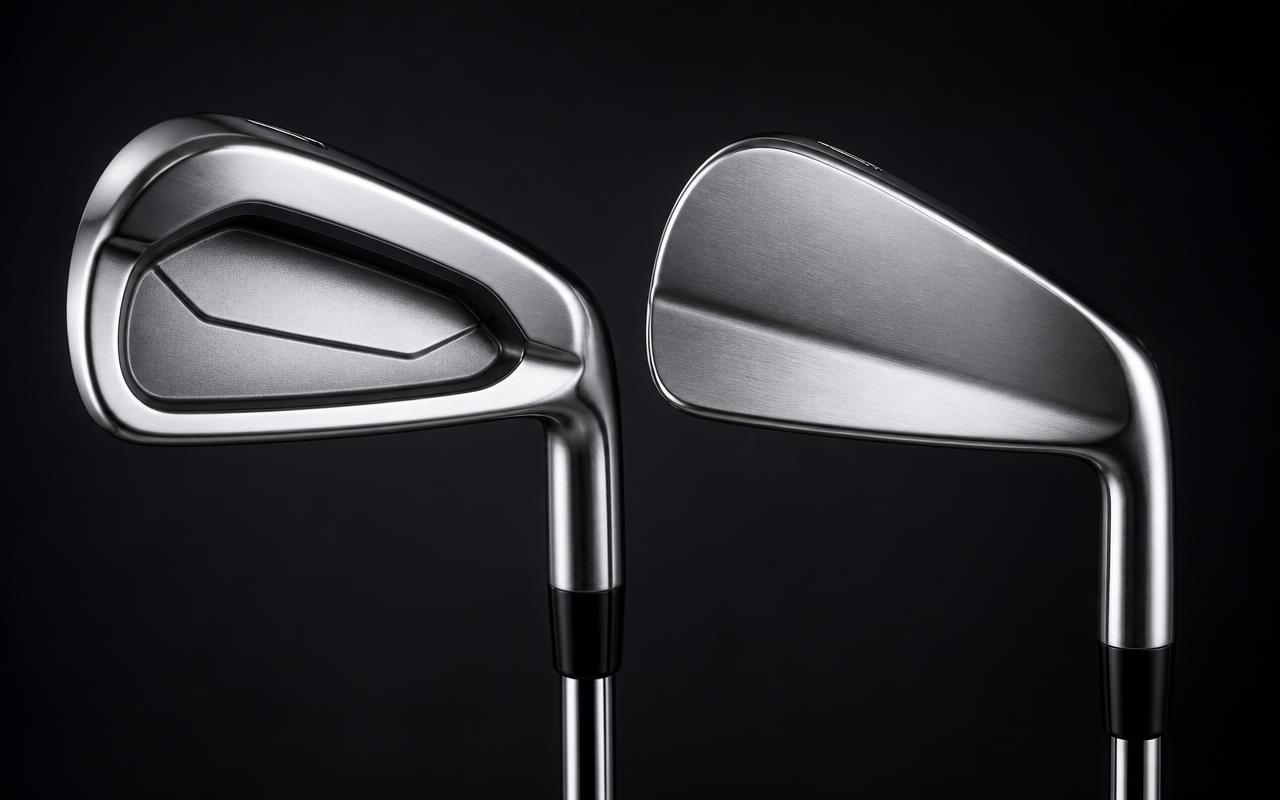
A blade iron, often referred to as a "muscle back," is characterized by a sleek, thin profile. The back of the clubhead is solid, with the mass concentrated directly behind the hitting area. These clubs typically feature a very thin top line, narrow soles, and minimal offset. They are designed for golfers who prioritize total control over the flight and shape of their shots.
Defining the Cavity Back Construction
Cavity back irons feature a hollowed-out section in the rear of the clubhead. By removing mass from the center, designers can redistribute that weight to the perimeter of the frame. This construction typically results in a larger clubhead, a thicker top line, and a wider sole. The primary goal is to provide stability when the ball is not struck perfectly in the center of the face.
The Engineering of Blade Irons
Muscle Back Geometry and Weight Distribution
The geometry of a blade iron is intentional. By keeping the mass concentrated in a small area, the club provides a dense, solid feel at impact. Because there is no perimeter weighting to resist twisting, the club responds immediately to the golfer's input. This allows skilled players to manipulate the clubface to create draws or fades more easily than with a more stable, cavity-styled head.
The Role of a Higher Center of Gravity
Blades generally feature a center of gravity (CG) that is higher and closer to the face than cavity backs. This higher CG helps produce a more penetrating ball flight with higher spin rates. For high-speed players, this prevents the ball from "ballooning" into the air and allows for better distance control, as the spin helps the ball hold its line against the wind.
Feedback and Vibrational Data
One of the most cited reasons for playing blades is feedback. When a ball is struck off-center on a blade, the vibration travels directly through the shaft to the golfer's hands, providing an immediate physical sensation of where the strike occurred. This sensory data is invaluable for elite players who use it to fine-tune their ball-striking consistency.
The Physics of Cavity Back Irons
Perimeter Weighting Explained
The fundamental principle of the cavity back is perimeter weighting. By moving mass to the extreme heel, toe, and sole, the club becomes more resistant to twisting on off-center hits. If you strike the ball toward the toe, the extra mass in that area prevents the face from opening as much as it would on a blade, helping the ball stay closer to the intended target line.
Increasing the Moment of Inertia (MOI)
Moment of Inertia, or MOI, is a measurement of a club's resistance to twisting. Cavity back irons are engineered to have a higher MOI than blades. This physics-based advantage means that even if your swing is slightly inconsistent, the club works to minimize the penalty. Higher MOI leads to more consistent ball speeds across a wider area of the clubface.
Lowering the Center of Gravity for Launch Assistance
Most cavity back designs feature a significant amount of weight in the sole. This lowers the center of gravity well below the midpoint of the ball. A lower CG makes it significantly easier to launch the ball high into the air, which is particularly beneficial for amateur golfers who may struggle with generating enough clubhead speed to create natural lift.
Performance Characteristics Comparison
Forgiveness and Off-Center Hit Stability
In the context of cavity back vs blade irons, forgiveness is the primary differentiator. A cavity back iron will retain more ball speed and maintain a straighter path on a "mishit." In contrast, a blade iron is unforgiving; a strike just a few millimeters off the sweet spot can result in a significant loss of distance and a deviation in direction.
Workability and Shot Shaping Capabilities
Workability refers to the ease with which a golfer can intentionally curve the ball or change its trajectory. Because blades are less resistant to twisting and have a more concentrated mass, they are highly workable. Elite players often prefer this because it allows them to navigate around obstacles or tuck into specific pin positions. Cavity backs, designed to go straight, can sometimes feel "stubborn" when trying to hit a deliberate hook or slice.
Distance Consistency vs. Peak Distance
While cavity back irons often produce more distance for the average player due to their lower CG and stronger lofts, blades offer superior distance consistency. A perfectly struck blade will travel a very predictable distance every time. Cavity backs, especially those with thin faces, can occasionally produce "fliers" or unexpected distance jumps, which can be a disadvantage for those who prioritize exact yardages.
Visual Profiles and Turf Interaction
Top Line Thickness and Offset
Visual preference plays a large role in club selection. Blades feature a thin top line that looks surgical and precise at address. Cavity backs have a thicker top line, which can provide a sense of confidence and "meat" behind the ball. Furthermore, cavity backs usually have more offset—the distance the leading edge sits behind the hosel—which helps the golfer square the face at impact.
Sole Width and Ground Interaction
The sole of the iron is what interacts with the turf. Blades have narrow soles that move through the grass quickly, requiring precise contact. Cavity backs feature wider soles that act as a safety net; if you hit slightly behind the ball, the wide sole helps the club glide along the surface rather than digging deep into the dirt, resulting in a better outcome for "fat" shots.
The Psychological Impact of the Address Position
Confidence is a critical component of the golf swing. Many amateurs find the small, intimidating profile of a blade causes tension in the swing. Conversely, some advanced players find the bulky look of a cavity back distracting. The psychological comfort of how a club looks at address is a valid factor in the cavity back vs blade irons decision.
Manufacturing Methods: Forged vs. Cast
The Forging Process and Grain Structure
Forging involves taking a solid piece of carbon steel and beating it into shape using high-pressure hammers. This process compresses the metal and aligns the grain structure, which many believe results in a "softer" feel. Historically, almost all blades were forged, leading to the common association between blades and a soft feel.
Investment Casting and Design Flexibility
Casting involves pouring molten metal into a mold. This method allows for complex geometries that forging cannot easily achieve, such as deep undercut cavities and internal weighting ports. While casting was once associated with a "clicky" or hard feel, modern alloys and heat treatments have made cast clubs feel remarkably similar to forged ones.
Common Misconceptions About Feel
It is a common myth that only blades can be forged and only cavity backs can be cast. Today, many manufacturers offer forged cavity back irons. The "feel" a golfer perceives is often a combination of the sound at impact, the location of the center of gravity, and the vibration dampening technology used in the clubhead, rather than the manufacturing method alone.
The Rise of Players' Distance and Hollow-Body Irons
The Middle Ground in Modern Equipment
A new category has emerged to bridge the gap in the cavity back vs blade irons debate: the players' distance iron. These clubs often use a hollow-body construction, where the iron looks like a blade from the outside but contains a hollow chamber filled with foam or microspheres to enhance forgiveness and ball speed.
Internal Weighting Systems
Hollow-body irons allow engineers to place heavy tungsten weights deep inside the head. This provides the high MOI of a cavity back while maintaining the clean, aesthetic lines of a blade. This technology has revolutionized the market for mid-to-low handicap golfers who want the best of both worlds.
Performance Thresholds for Hybrid Designs
These hybrid designs are not for everyone. While they offer speed, they can sometimes lack the precise feedback of a true blade or the ultimate stability of a game-improvement cavity back. They represent a specialized solution for the golfer who strikes the ball well but needs a boost in launch and distance.
Matching Iron Style to Your Skill Level
Handicap Ranges and Equipment Suitability
Generally, golfers with a handicap above 15 will see significant benefits from the forgiveness of cavity back irons. Players in the 5 to 15 range often find success with "players' cavity" designs. Truly traditional blades are typically reserved for those with handicaps near scratch (zero) or better, as these players have the strike consistency to handle the lack of forgiveness.
Ball Striking Consistency Requirements
The true test is your strike pattern. If your impact marks are scattered across the face of the club, a cavity back is a mathematical necessity to maintain reasonable scores. If your impact marks are concentrated in a circle the size of a dime, you may have the skill set to consider the precision of a blade.
The Importance of Professional Fitting
Regardless of your handicap, a professional fitting is essential. A fitter can use launch monitor data to show you exactly how much distance you lose on off-center hits with a blade versus a cavity back. Often, the data reveals that even good players benefit from a little more help than they initially thought.
The Concept of Combo or Blended Sets
Why Pros Use Mixed Sets
Even on the professional tours, many players no longer use a full set of blades. A "combo set" involves using cavity back irons for the long irons (3, 4, 5) to help with launch and forgiveness, while using blades for the short irons (8, 9, PW) where precision and scoring are the focus.
Managing Loft Gapping in Blended Sets
The challenge with blended sets is ensuring that the distance gaps between clubs remain consistent. Because cavity backs often have stronger lofts, a professional must often bend the lofts of a mixed set to ensure a seamless transition from one club type to the next.
Optimal Transition Points in the Bag
Most golfers find the transition point around the 6 or 7 iron. The 4 and 5 irons are naturally harder to hit, making them prime candidates for cavity back technology. The shorter irons are naturally more forgiving due to their higher lofts, making them easier to play in a blade profile.
Making the Final Decision for Your Game
Analyzing Your Typical Miss
To choose between cavity back vs blade irons, look at your common mistakes. If your miss is a "thin" shot or a strike off the toe that falls 20 yards short of the green, the cavity back is your best friend. If your "miss" is simply hitting the ball 2 yards further than intended, you may be ready for a blade.
Prioritizing Distance vs. Control
Ask yourself what your game needs most. If you are struggling to reach par-4s in two shots, the distance-boosting technology of a cavity back is vital. If you find yourself in the fairway consistently but struggle to hit the ball close to the pin, the control of a blade might be the missing link.
Long-Term Development Considerations
Some golfers choose blades as a way to "force" themselves to become better ball strikers, believing the harsh feedback will accelerate their learning. However, for most, the enjoyment of the game comes from better results. Modern cavity back designs are so advanced that they no longer carry the stigma of being "beginner clubs," making them a viable long-term choice for golfers of all levels.
Frequently Asked Questions
Do blade irons actually hit the ball shorter than cavity backs?
Technically, a blade does not have a slower face, but they often have "weaker" (higher) lofts to help with control and spin. Additionally, because they are less forgiving, the average distance over ten shots is usually lower for most golfers because the off-center hits lose significant speed.
Why are blade irons considered harder to play?
Blades are harder to play because they have a very small "sweet spot." If you do not hit the ball exactly in the center, the clubhead will twist, resulting in a loss of distance and accuracy. They also provide less help in getting the ball airborne.
Can a high-handicapper use blade irons to improve their game?
While possible, it is generally not recommended. The lack of forgiveness can lead to frustration and a loss of confidence. Most instructors suggest mastering ball striking with a more forgiving club before moving to a demanding blade profile.
What does 'perimeter weighting' mean in cavity back clubs?
Perimeter weighting refers to the distribution of weight around the outside edges of the clubhead. This increases the Moment of Inertia (MOI), which stabilizes the club against twisting when the ball is struck toward the toe or the heel.
Are all forged irons considered blades?
No. While most blades are forged, many modern cavity back and players' distance irons are also forged. Forging is a manufacturing process, whereas "blade" refers to the specific shape and weight distribution of the clubhead.
At what handicap should I switch to a more compact iron profile?
There is no set rule, but many golfers consider moving to a more compact "players' iron" when their handicap reaches single digits (under 10). However, ball-striking consistency and personal preference are more important factors than the handicap number itself.
Conclusion
The choice between cavity back vs blade irons ultimately comes down to a balance of physics and personal preference. Cavity backs offer the technological assistance that most golfers need to manage the inherent difficulties of the game, providing higher launch and stability. Blades offer a level of feedback and shot-shaping capability that serves as the gold standard for elite performance. By understanding your own swing, your typical miss, and your goals on the course, you can select the iron design that provides the best opportunity for lower scores and a more enjoyable round of golf.
What we like
- Clear spec differences that affect ball flight
- Options across a wide price range
- Widely available in US retail
Things to consider
- Fitting matters more than model names
- Premium tiers add cost for small gains
- Stock and pricing vary by season
Frequently asked questions
Parspun Editorial Team
The Parspun editorial team writes plain-English gear guidance for everyday golfers, focused on specs, fit and value rather than hype.
Get the next guide first
Occasional emails with new gear guides. Double opt-in, unsubscribe anytime.


