Mastering Your Swing: Best Golf Training Aids for Practice at Home
Transform your living room into a high-performance training facility. This guide explores the most effective golf training aids for home use, focusing on muscle memory, tempo, and short-game precision.
Parspun is reader-supported. When you buy through links on our site, we may earn an affiliate commission at no extra cost to you.
This article contains information intended to help golfers improve their game through home practice. We may earn a commission from purchases made through links on this page.
The Benefits of Establishing a Home Practice Routine
Improving your golf game no longer requires a daily trip to the driving range. With the right home setup, amateur golfers can refine their swing mechanics, putting stroke, and tempo from the comfort of their living room or backyard. This guide breaks down the essential categories of the best golf training aids for practice at home that target specific areas of improvement, helping you build a more consistent game through purposeful practice.
Consistent Muscle Memory Development
The primary advantage of practicing at home is the ability to engage in high-frequency, low-intensity training. Instead of a single two-hour session once a week at the range, home practice allows for 15-minute daily sessions. These frequent interactions with the club help cement neurological pathways, making your swing feel more natural when you eventually step onto the first tee. By focusing on specific movements without the pressure of ball flight, you can isolate technical flaws more effectively.
Cost-Effective Skill Building
Range buckets and green fees add up quickly. Investing in home training tools often pays for itself within a single season. Beyond the financial savings, you save the time associated with commuting to a facility. This efficiency allows you to spend more time actually swinging the club rather than sitting in traffic or waiting for an open hitting bay.
Focused Practice Without Distractions
The driving range can be a social environment, which is excellent for enjoyment but often detrimental to technical progress. At home, you can eliminate the "ego-hitting" that occurs when trying to outdrive the person in the next bay. You are free to perform exaggerated drills or slow-motion swings that might feel embarrassing in public but are vital for changing swing patterns.
Essential Putting Aids for the Living Room
Putting accounts for approximately 40% of all shots in a typical round, making it the most logical place to start a home practice routine. The best golf training aids for practice at home in this category focus on three pillars: path, face angle, and speed.
Surface Materials and Green Speeds
Modern putting mats have evolved significantly from the basic felt strips of the past. High-quality home greens often feature synthetic fibers designed to mimic the grain and friction of real bentgrass or bermuda. When selecting a mat, look for one that offers a consistent Stimpmeter rating. Practicing on a surface that is too slow or too fast compared to your local course can lead to poor distance control habits.
Alignment and Path Tools
Most three-putts are the result of poor alignment or a clubface that is open or closed at impact. Mirrors are among the most effective tools here; they allow you to check your eye position relative to the ball and ensure your shoulders are square. Similarly, putting gates or rails help you visualize the proper arc of the stroke, ensuring the putter head travels on the intended line.
Distance Control Drills
Distance control is about rhythm and stroke length. Home practice allows you to use calibrated markings on a mat to develop a sense of how far the ball travels with a six-inch backstroke versus a ten-inch backstroke. Using small targets or pressure-sensitive trainers that return the ball only on a perfect strike can sharpen your touch significantly.
Full Swing Mechanics and Path Trainers
Translating a home practice session into a powerful, on-course swing requires tools that provide physical feedback. Since you cannot always see where the ball goes, you must rely on tools that tell you how the club is moving through space.
Weighted Swing Trainers for Tempo
Many golfers struggle with a transition that is too fast or jerky at the top of the swing. Weighted trainers, often featuring flexible shafts, force the golfer to wait for the "load" of the club. If you rush the downswing, the flexible shaft will wobble, providing immediate feedback that your timing is off. These tools are excellent for warming up and increasing your natural swing rhythm.
Impact Bags for Proper Compression
An impact bag is a heavy-duty, foam-filled bag designed to be hit at partial speed. It helps golfers feel the moment of truth: impact. By striking the bag, you can check if your hands are ahead of the clubhead (creating shaft lean) or if you are "flipping" your wrists. It is a safe way to build the strength needed for a stable impact position without the vibration of hitting a hard object.
Alignment Sticks and Visual Cues
Simple but essential, alignment sticks are the Swiss Army knife of golf practice. They can be used to check foot alignment, create a "gate" for the clubhead to pass through, or serve as a visual plane line. Placing one stick in the ground (or a heavy base) at the angle of your club shaft can help prevent an over-the-top move or a swing that is too flat.
Maximizing Feedback with Hitting Nets and Mats
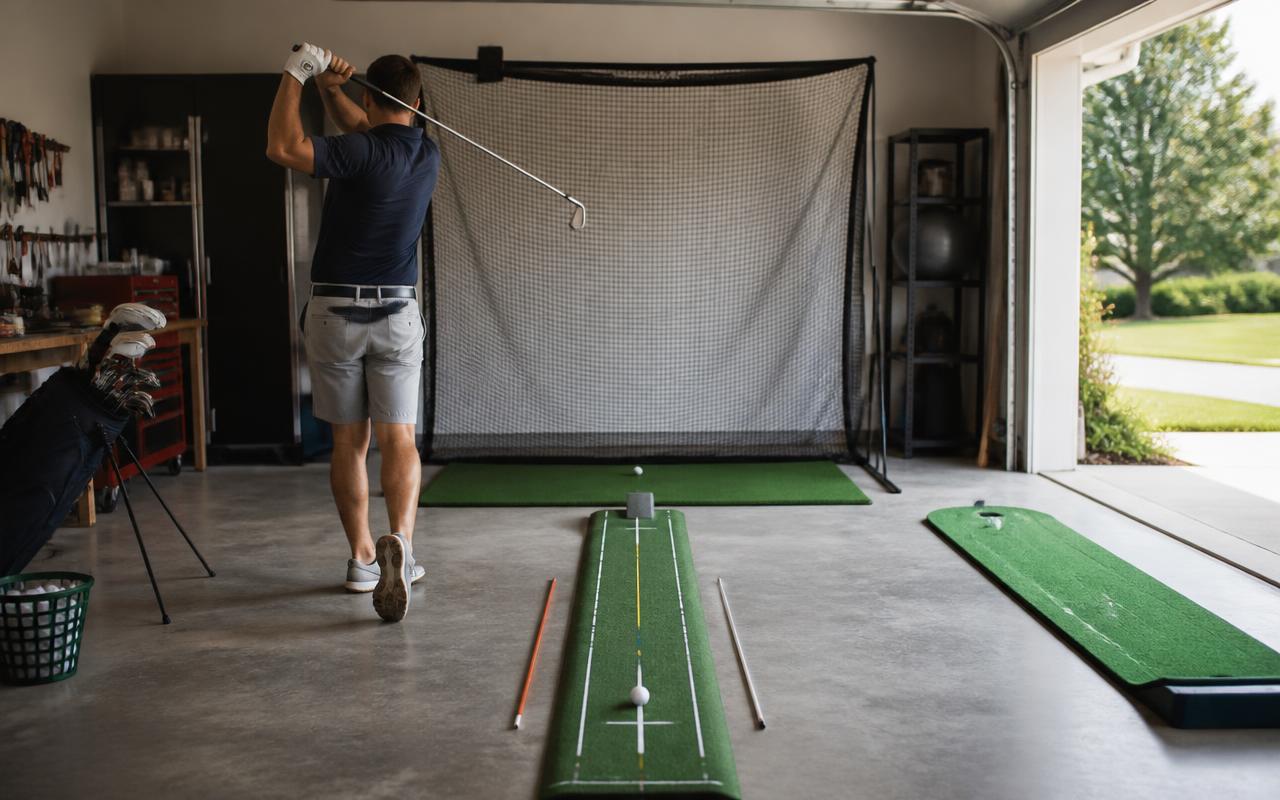
If you have the space in a garage or backyard, a full hitting setup is the gold standard for home practice. However, the quality of your equipment determines both your safety and the longevity of your clubs.
Durability Standards for Indoor Hitting
Not all nets are created equal. High-impact netting, often made of polyester or nylon with a tight weave, is necessary to stop balls traveling at high velocities. Look for nets with a "baffle" or a secondary layer of mesh in the primary impact zone, as this is where wear and tear happen fastest. A net failure indoors can lead to significant property damage.
Turf Quality and Joint Protection
One of the biggest risks of home practice is hitting off a thin, hard mat. Repeatedly striking a firm surface can lead to elbow tendonitis or wrist injuries. The best mats utilize a thick foam base or a "gel" layer that simulates the give of real turf. This allows the club to move through the surface rather than bouncing off it, protecting your joints and providing a more realistic feel of a divot.
Safety Considerations for Home Setups
Ensure you have at least 10 feet of ceiling height for a full driver swing, though this varies based on the golfer's height. Additionally, always leave a "buffer zone" behind the net. Never place a net directly against a wall; the ball needs room to stretch the netting and dissipate energy. Side wings or side barriers are also recommended to catch occasional shanks or toe-strikes.
Analyzing Ball Flight Data at Home
The primary downside of hitting into a net is the lack of ball flight feedback. Personal launch monitors have bridged this gap, making high-level data accessible to the average consumer.
Entry-Level Personal Launch Monitors
Modern portable monitors use radar or high-speed cameras to track the ball for the first few feet of flight. While professional-grade units are expensive, entry-level devices provide remarkably accurate data on carry distance and ball speed. These devices usually sync with a smartphone or tablet to display your stats instantly.
Key Metrics to Track During Practice
When practicing at home, focus on three primary metrics: Carry Distance, Smash Factor, and Launch Angle. Smash factor (ball speed divided by clubhead speed) tells you how centered your contact was. If your smash factor is low despite high swing speed, you know you are missing the sweet spot. Tracking these numbers ensures that your home sessions are productive rather than just "exercise."
Simulating On-Course Scenarios
Many launch monitors include basic simulation software. Instead of just hitting 50 drivers, you can play a virtual hole. This forces you to switch clubs—hitting a driver, then a 7-iron, then a wedge. This "random practice" is far more effective for skill transfer than "blocked practice" where you hit the same club repeatedly.
Developing Speed and Strength Off the Course
Golf is an athletic endeavor, and home practice should include physical conditioning. The best golf training aids for practice at home often focus on increasing clubhead speed through neurological training.
Overspeed Training Systems
These systems usually consist of three clubs of varying weights (light, medium, and heavy). By swinging the lighter club faster than your normal driver, you teach your brain and muscles that a higher speed is possible. Over time, this resets your "speed ceiling," leading to measurable gains in distance on the course.
Resistance Tools for Rotational Power
Resistance bands or specialized golf cords can be anchored to a door or post. By performing slow, resisted golf rotations, you strengthen the core, glutes, and obliques. This building of rotational power is key to maintaining a stable posture throughout the swing and preventing the late-round fatigue that leads to errant shots.
Flexibility Aids for Increased Range of Motion
A restricted backswing is often a result of poor thoracic mobility or tight hips. Weighted stretching poles or simple foam rollers can be used to improve your range of motion. A more flexible golfer can create a wider arc, which naturally leads to more speed without needing to swing "harder."
Creating a Structured Home Practice Plan
Having the tools is only half the battle; you must use them effectively. A common mistake is practicing without a clear objective.
Setting Specific Weekly Goals
Rather than a vague goal like "get better," set measurable targets. For example: "I will achieve a 1.45 smash factor on 10 consecutive shots," or "I will make 20 five-foot putts in a row." These milestones keep you engaged and provide a sense of accomplishment.
Balancing Technical Drills with Play
Split your time between technical work and performance work. Spend the first 15 minutes on a specific drill (like an impact bag drill) and the final 15 minutes on "performance," where you try to hit targets or play virtual holes. This helps bridge the gap between a "practice swing" and a "real swing."
Tracking Progress Over Time
Keep a simple log of your sessions. Note your average carry distances and any swing thoughts that felt particularly effective. Over weeks and months, you will start to see patterns in your data that can help your local PGA professional diagnose issues more quickly during your next in-person lesson.
Common Pitfalls to Avoid in Home Practice
Without a coach watching, it is easy to reinforce bad habits. Awareness is the key to avoiding these traps.
Practicing Without Feedback
Hitting 100 balls into a net without a launch monitor or a mirror can be dangerous. You might be hitting a massive slice, but without seeing the ball flight or the club path, you could be unknowingly perfecting that slice. Always use at least one form of feedback (video, sticks, or data).
Neglecting the Short Game
It is tempting to spend all your time in the garage hitting drivers. However, home is the best place to work on the "boring" fundamentals of chipping and putting. Ensure at least 50% of your home practice time is dedicated to shots under 50 yards.
Over-relying on Training Aids
A training aid is a crutch designed to teach a feeling. If you use a path trainer for every single swing, you may become dependent on it. The goal is to use the aid for a few swings to find the feeling, then try to replicate that feeling without the aid.
Selection Criteria for Home Training Aids
When we evaluate the best golf training aids for practice at home, we look for tools that meet specific standards of utility. First, the aid must provide immediate, objective feedback—you shouldn't have to guess if you did it right. Second, it should be durable enough for repeated use. Third, it should be easy to set up and store; a tool that stays in the box is a tool that doesn't help your game. Finally, we prioritize aids that translate directly to on-course movements rather than those that encourage artificial or non-functional swing patterns.
FAQ
How much space is needed for a full swing home practice setup?
For a full swing, you typically need a room that is at least 10 feet high, 12 feet wide, and 15 feet deep. This allows enough clearance for the club's arc and provides a safe distance between the hitting mat and the net to prevent ball rebound.
Can practicing on a mat cause injuries to my joints?
It can if the mat is too thin or placed directly on concrete. To avoid repetitive strain injuries like "golfer's elbow," invest in a high-quality mat with a thick, shock-absorbing base that mimics the feel of real turf.
How often should I use training aids during a practice session?
Aids are most effective when used in intervals. Try the "3-to-1 rule": perform three swings with the training aid to lock in the sensation, followed by one swing without it to see if you can retain the movement naturally.
Do home putting mats accurately reflect real green speeds?
Many premium mats are designed to roll at a specific Stimpmeter speed, often between 9 and 11, which reflects a typical mid-to-high-end golf course. Always check the product details to ensure the speed matches the conditions you usually play in.
Are swing speed trainers safe for senior golfers?
Yes, but they should be used with caution. Seniors should focus on a thorough warm-up before using overspeed tools and should prioritize the lighter clubs in a set to avoid straining the back or shoulders.
Conclusion
Building a home practice sanctuary is one of the most effective ways for an amateur golfer to see rapid improvement. By selecting the best golf training aids for practice at home—focusing on putting precision, swing path feedback, and data-driven analysis—you turn idle time into a competitive advantage. Remember that consistency beats intensity; a few minutes of focused work every day will always outperform a marathon session once a month. With the right tools and a structured plan, you can step onto the course with the confidence that your game is built on a foundation of solid mechanics developed right in your own home.
What we like
- Clear spec differences that affect ball flight
- Options across a wide price range
- Widely available in US retail
Things to consider
- Fitting matters more than model names
- Premium tiers add cost for small gains
- Stock and pricing vary by season
Frequently asked questions
Parspun Editorial Team
The Parspun editorial team writes plain-English gear guidance for everyday golfers, focused on specs, fit and value rather than hype.
Get the next guide first
Occasional emails with new gear guides. Double opt-in, unsubscribe anytime.


